Forest streams
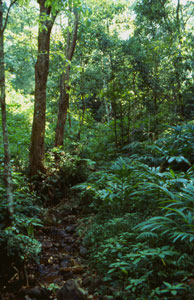
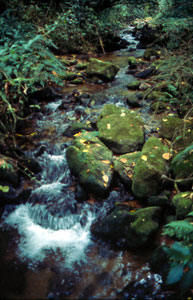
Most diverse running water beetle fauna can be found in relatively small to moderately large forest streams. These should be about 0.5-2 m wide and not entirely shaded. Complete shade prevents growth of algae, which are a principal diet for most elmids. Moreover, the stream should be reasonably clean, without silt and mud deposits. Adult elmid beetles breathe by means of plastron, a more-or-less extensive pubescence consisting of very fine hairs that helps them take water-dissolved oxygen. They thus cannot survive without more or less moving (running) water.
| 
|
|---|
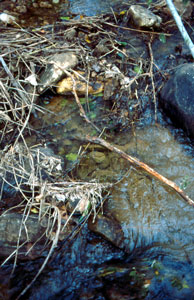
Some species prefer strong current and can be found only in rapids and fast flowing riffles, others prefer slower current or live in a variety of other microhabitats. One should therefore also look e.g. for accumulated leaf/detritus packs and aquatic mosses. For example, moss-overgrown stones can harbour a variety of beetles that live both in the "spray zone" just above the water level (Staphylinidae: Stenus, Microsporidae, Limnichidae) as well as underwater (in southern India, I found some species of Podelmis only that way). Adults of some species of the elmid subfamily Larainae may be found on half-submerged wood and rocks. Other species are associated with submerged wood. The structure of the stream bottom may also be important - elmid beetles are generally not "digging burrowers" and therefore need some space to crawl around. Fine gravel and (not very smooth) pebbles seem to be O.K. for many species, although some very small species (such as the elmids Austrolimnius and Zaitzeviaria, ca. 1 mm in size) seem to prefer very fine gravel in slower parts of streams.
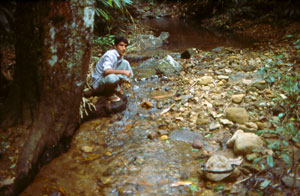
Also, don't miss the gravel/pebble shore. Many species (e.g. Hydraenidae) live along the water line in fine gravel and can be found by "tearing down" the shoreline below water. The beetles float up to the water surface and can be easily collected with a small tea strainer (unless the current is strong and washes them away quickly). Many beetles (Heteroceridae, Dryopidae, Limnichidae, Carabidae, Georissidae) can also be found by spraying the shores; most of them would start to run among the gravel and many would require fast reaction, since they often fly away readily.